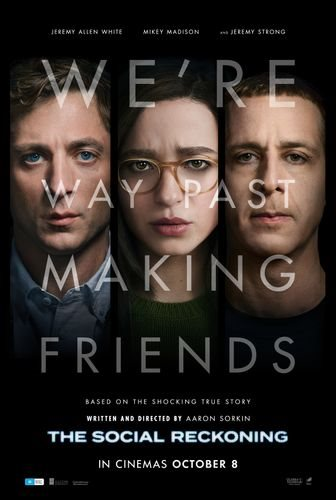

Two decades after Facebook’s founding, the transformative social media platform is now a global corporate behemoth, twice as big as any country, employing an algorithm that influences both personal lives and world governments daily. This new reality, one we’re all living in the middle of, forms the high-stakes backdrop of Aaron Sorkin’s The Social Reckoning. The whistleblower thriller is a tale of fragile trust unfolding between a gritty reporter and brilliant insider who join forces to uncover Facebook’s closest-held secrets. But at the heart of the suspense lies a core question of our times: what happens when society’s most precious commodity becomes human attention itself?
The film sees Sorkin, the man who rewrote the rules of movie dialogue, taking on the engine of our age of toxic conversation. In 2010, Sorkin wrote the Academy Award-winning screenplay for The Social Network. Directed by David Fincher, the film became an instant touchstone, a tense, witty, quotable, downright forensic unraveling of how innovation happens. The meteoric rise of Facebook and its billionaire CEO Mark Zuckerberg was a tale of daring, hubris, back-stabbing, and the messiness of creation. But now comes a very different story of creation’s consequences. Of a nation hooked. Of a band of disruptors turned into a staunchly-guarded hub of unimagined power with the potential to connect the planet…yet sowing division, extremism, and disinformation across it.
How did we get here? That question lures whistleblower Frances Haugen and reporter Jeff Horwitz in The Social Reckoning into a tangled web of hidden documents, corporate image-making, and moral conflict. New to the Wall Street Journal as a tech reporter, Jeff barely knows a bit from a byte. But he runs into a blockbuster story when Frances, a mid-level Facebook engineer, reaches out for a covert meeting. A true believer in Facebook’s original ideals, Frances defies the company’s culture of silence because she fears they are steering their ingenious algorithm in a perilous direction, knowing it can damage children, mental health, even democracy itself. Pushing each other to their limits, Jeff and Frances risk everything in a landmark investigation soon to be known as “The Facebook Files.” “The Social Network was about how Facebook was invented.
The Social Reckoning is about what social media has become,” Sorkin says. A companion piece to his earlier screenplay, The Social Reckoning is a stand-alone story set against an entirely different moment in time, of a now-vast corporate fixture making world-altering decisions in the shadows.
The problem is that much of what Facebook is sending out into the water supply is simply wrong. Facebook is gushing out mass misinformation, things that outrage and anger you, so that you will keep resharing.”
Though the film is layered with revelations, it never judges its characters. And though the story weaves through Congressional hearings and global breaking news, Sorkin sees the subject matter as far beyond politics. “It’s not about red or blue. It’s about a problem we all have together,” he says. In the heady beginning, social media platforms presented themselves as neutral conduits for free expression, akin to a telephone wire or a town square, requiring only minimal self-regulation. But then the algorithm became king. Able to amplify or suppress messages, algorithms put a thumb on the scales. And as they grew more complex, pervasive, and attuned to high-emotion human responses, they changed the game. Far from neutral, algorithms began surreptitiously reshaping what ideas we bump into on our private feeds, while forging a warped, more sensationalized view of every subject.
The Social Reckoning explores this insidious power of the algorithm from within a tale of ratcheting momentum set in motion by Sorkin’s trademark complex characters and rapid-fire dialogue. Says Mikey Madison, who took a dive into the tech realm to portray whistleblower Haugen, “It’s an eye-opener to see how algorithms can so easily lead us down a distorted path. The word reckoning in the title really sets the tone.”
Jeremy Allen White, who brings an Everyman quality to in-over-his-head newsman Horwitz, adds, “Like all of Sorkin’s work, The Social Reckoning is smart, funny, tense, and extremely culturally relevant. The focus is on what social media is doing to us all as people.” For Jeremy Strong, who portrays Mark Zuckerberg not as the youthful inventor, but a man confronted by the enormity of his power, Sorkin was the only person who could unravel this tale. “Shakespeare wrote that the role of art is to hold a mirror up to nature and to ‘show the very age and body of the time, its form and pressure.’ Aaron has devoted a large part of his body of work to doing just that, to showing us the form and pressure of our times, and I think this film is his magnum opus.”